Cost the order
Separate material consumption, labor allowance, packaging per piece and costs charged once per order.
Plan labor, materials and the packs needed for the whole order, then compare a single item with a batch.
Free: compare fixed sample orders. Paid kit: enter your own costs, stock and making times in English and Italian workbooks and compare order quantities.
Two editable XLSX workbooks · English + Italian · Version 1.0.1
216 g consumed. Two 200 g packs bought at an invented €10 per pack. 184 g remain. Do not add the purchase cash to the consumed cost.
A proposed price has to cover more than materials. Enter making time, setup, packaging, shipping you absorb and other allocated costs. Then compare the quantities and the cash you need before making the order.
Separate material consumption, labor allowance, packaging per piece and costs charged once per order.
Use your declared stock snapshot to find missing packs and the quantity left after this order.
Keep three editable quantity alternatives beside your current plan. Setup follows the stated batch mode and capacity.
Choose a predefined fictional case and order size. The figures are calculated from the kit’s original worked inputs. This demonstration does not accept your costs, open files, save work or send measurement events.
All example costs, time, proposed prices and fees are invented teaching inputs, not market rates.
Residual is after the costs entered in this scenario and before personal taxes, contributions and any costs omitted. It is not net income or a sales forecast.
The threshold uses the stated target margin and entered fees. For a mixed order it is an average for the mix, not a recommended price for each item or evidence a buyer will accept it.
| Material | Needed | Starting stock | Packs to buy | Purchase cash | Quantity left |
|---|---|---|---|---|---|
| Cotton | 216 g | 0 g | 2 | €20.00 | 184 g |
One fixed fee per order/payment, plus the entered percentage applied to revenue. No buyer-paid shipping, sales tax or exchange-rate calculation.
Each selection starts from the same original stock snapshot. Changing the quantity does not consume or update inventory.
Faithful workbook renders with the original fictional coaster example. Amber cells are editable. Open an image to inspect the full sheet.
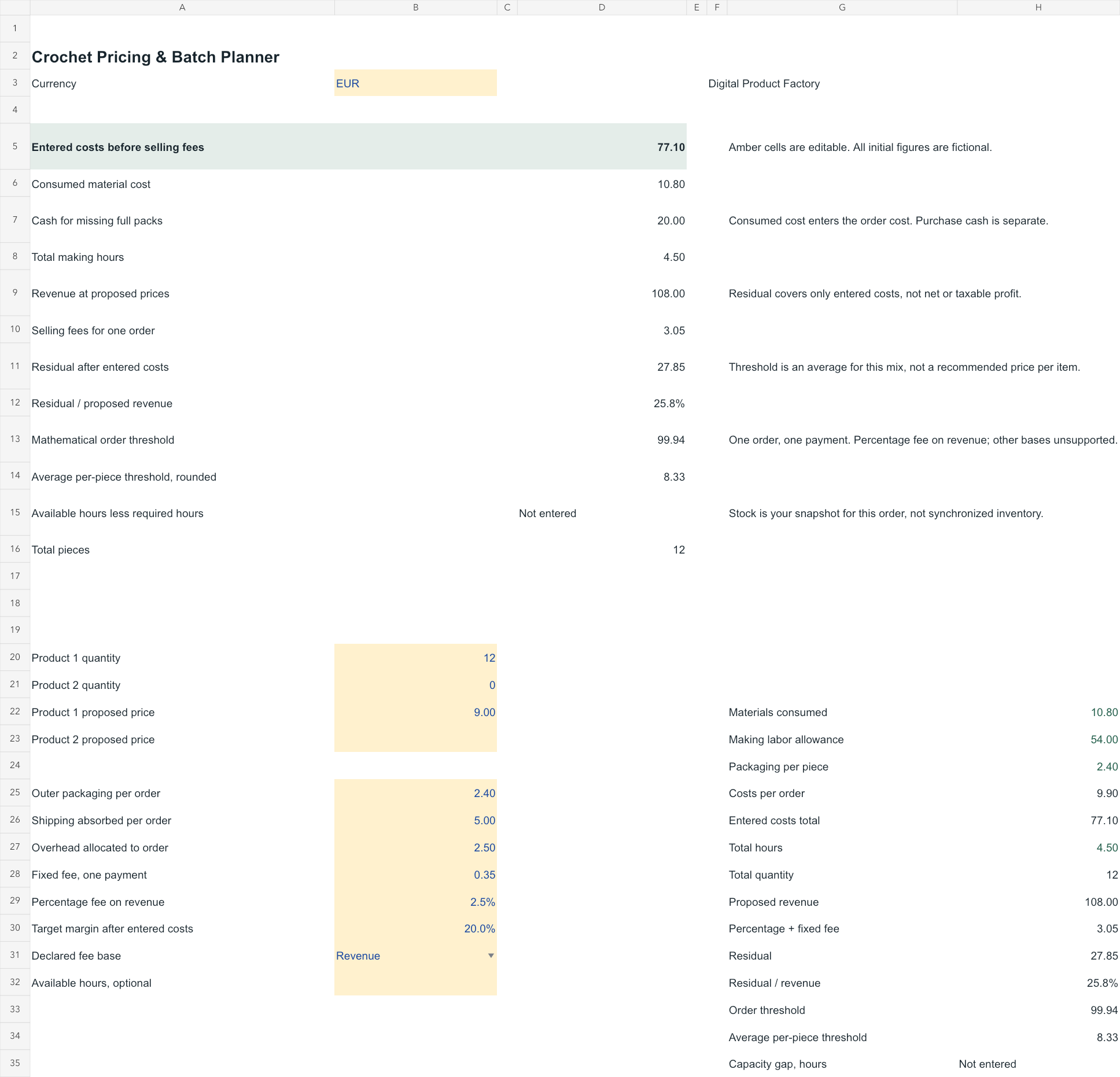
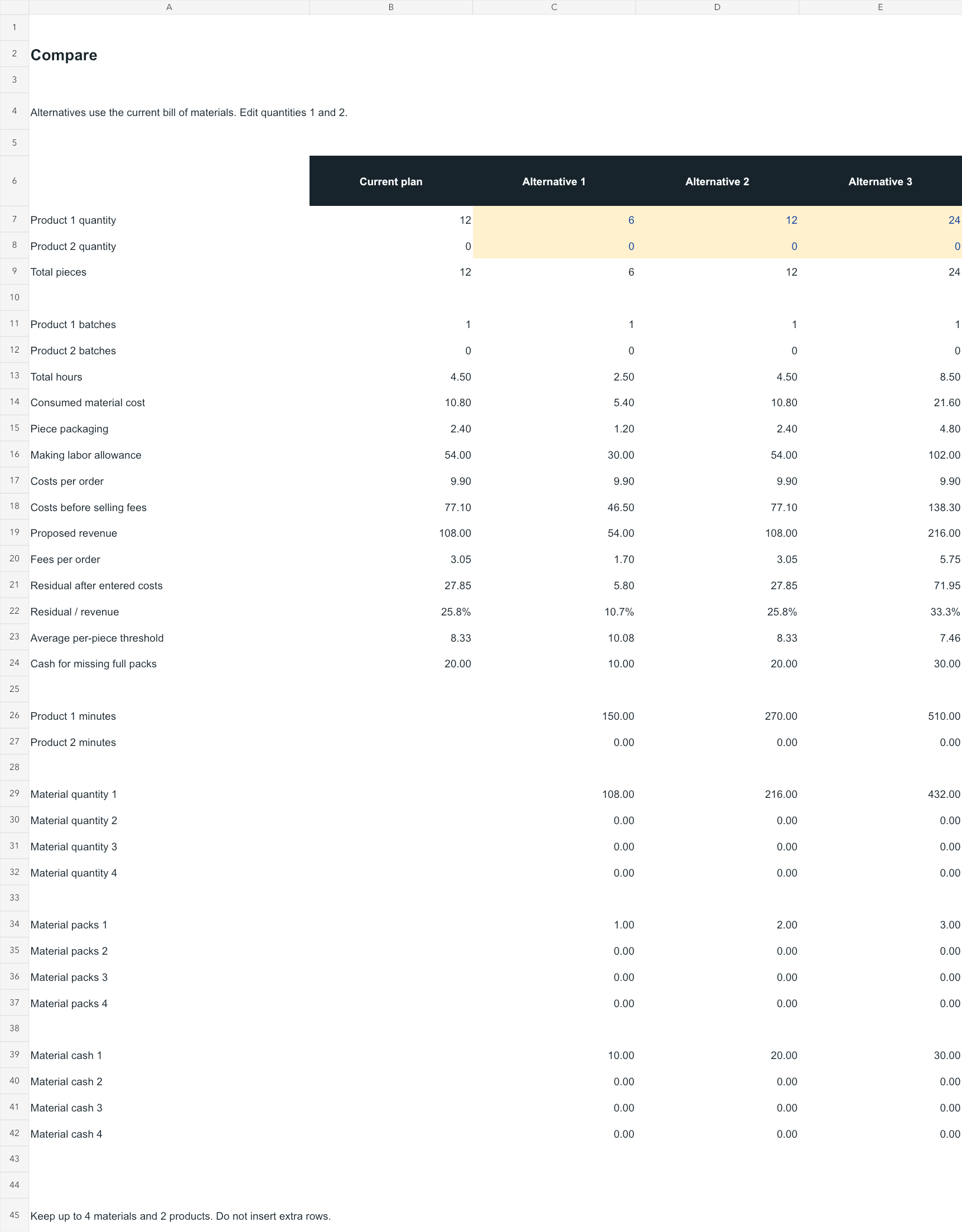
One ZIP with 16 files. The paid package contains XLSX workbooks; the separate private browser calculator is not included.
Use the English or Italian workbook and follow its guide. Replace the fictional values in the editable cells with your own quantities, stock, times, costs and proposed prices. Keep the sheet structure and save copies of your scenarios.
The workbook does not automatically import JSON or select a worked case. JSON files document the example inputs; the guides explain which values to enter manually. Currency labels are editable, without conversion.
Workbook formulas, exported files and reimported results have been checked locally. Native Excel/Google Sheets, printing and this release’s purchase and delivery checks are still pending.
One business or internal team may customize the planner and share completed outputs with relevant collaborators or clients. Do not redistribute or resell the template files or original examples.
€19
Crochet Pricing & Batch Planner
€19 is a one-time price hypothesis, not validated. Commercial terms will be completed before purchase is enabled.
This product is prepared for review. Purchases and automatic delivery are not active.
Support identity and contact details will be completed before checkout is enabled.
For 12 fictional coasters, 216 g of cotton cost €10.80 at the entered pack price. With zero stock, two 200 g packs cost €20 to buy and leave 184 g. The consumed cost enters the order cost; purchase cash is a separate planning figure. Adding both would count the material twice.
The planner values consumption using the pack price you enter. Stock changes the packs you need to buy. It does not erase the material consumed or synchronize a warehouse.
You enter proposed prices and cost assumptions. The threshold is a mathematical scenario, not a market recommendation, guaranteed profit or proof of demand.
No automatic exchange conversion, text translation or JSON import into Excel is included. The two workbook editions and guides are authored in English and Italian; worked values are entered manually.